What Is a Dental Bridge?
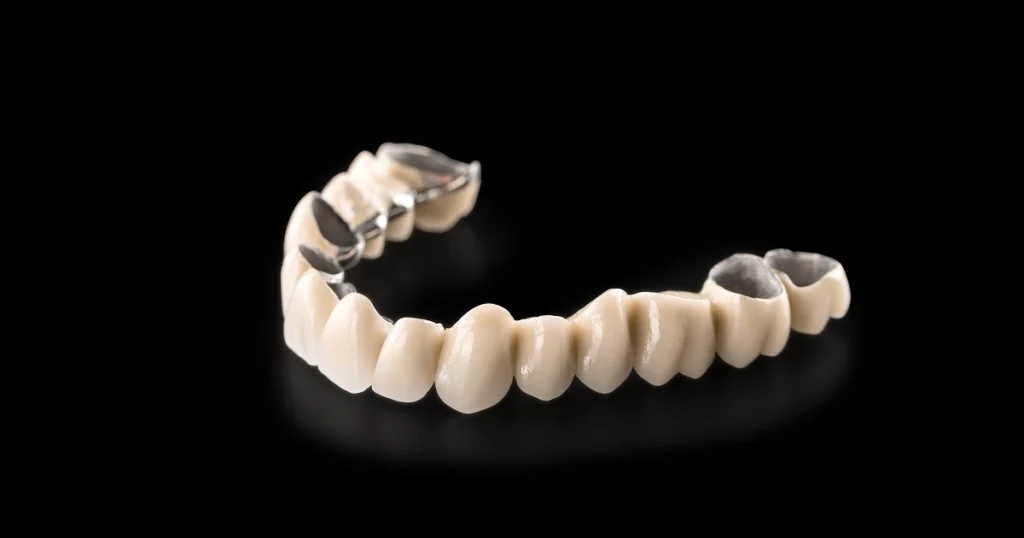
A dental bridge literally “bridges” the gap left by a missing tooth. It’s made up of a false tooth, called a pontic, that sits where your natural tooth used to be. That pontic is held in place by crowns on the healthy teeth on either side of the gap.
To do this, your dentist reshapes those two neighboring teeth and caps them with crowns, which anchor the bridge. The result is a fixed restoration — it isn’t removable like a partial denture, and it stays put when you eat and talk. The trade-off is that a bridge leans on your natural teeth for support, and those supporting teeth have to be reshaped to make it work.
What Is a Dental Implant?
A dental implant replaces the whole tooth, root and all. It’s a small titanium post that your dentist places directly into your jawbone, where it acts as an artificial tooth root. Over a few months, the bone naturally grows around and fuses to the post in a process called osseointegration, which gives the implant a stable, lasting foundation.
Once it has healed, the post is topped with a custom crown that looks and functions like a natural tooth. Because an implant stands on its own root, it doesn’t touch or depend on the neighboring teeth at all — they’re left completely intact. This is a key part of the difference between a bridge and an implant.
Bridge vs. Implant: The Key Differences
Here’s a side-by-side look at how a dental bridge or implant compares across the things that matter most:
What matters | Dental Bridge | Dental Implant |
|---|---|---|
How it’s supported | Leans on the neighboring teeth, which are crowned | Stands on its own root in the jawbone |
Effect on adjacent teeth | Requires reshaping healthy neighbors | Leaves neighboring teeth untouched |
Bone health | Does not stimulate the bone under the gap | Stimulates and helps preserve the jawbone |
Longevity | Durable, but typically needs replacing sooner | Can last decades with good care |
Time / process | Faster — often completed in a few weeks | Longer — months of healing for osseointegration |
Candidacy | An option when bone is limited or neighbors need crowns | Needs enough healthy bone and gum |
Cleaning / maintenance | Need to clean carefully under the pontic | Brush and floss like a natural tooth |
Cost | Lower upfront, but replacement over time adds up | Often higher upfront, strong long-term value |
Numbers for longevity and cost vary from person to person, so treat these as general patterns rather than promises — your dentist can give you a realistic picture after an exam.
Pros and Cons of a Dental Bridge
Pros:
- Faster timeline — no waiting months for bone to heal
- No surgery required
- Lower upfront cost
- A sensible choice when the neighboring teeth already need crowns anyway
Cons:
- Requires reshaping otherwise-healthy teeth
- Doesn’t preserve the bone beneath the gap, which can shrink over time
- Usually has a shorter lifespan than an implant
- Can be harder to clean underneath the pontic, which takes extra care
Which One Is Right for You?
In the implant vs bridge conversation, there’s no single answer that fits everyone. The right choice depends on your bone health, the condition of your neighboring teeth, your timeline, your budget, and your long-term goals.
For a single missing tooth, dental implants are often considered the long-term gold standard when you’re a candidate — they protect the bone, leave your other teeth alone, and tend to last the longest. That said, a bridge can genuinely be the better fit in certain situations: for example, when the neighboring teeth already need crowns, when there isn’t enough bone for an implant without grafting, or when you need a faster timeline.
The only way to know for sure is a professional exam with imaging, which shows what’s happening with your bone and the teeth around the gap. EXO Dental is implant-led, and our dentists will walk you through both paths honestly — including when a bridge is the smarter choice for you.
Why It Matters to Replace a Missing Tooth
A gap is about more than appearance. When a tooth goes missing, the neighboring teeth can gradually drift and shift into the space, which can throw off your bite and make chewing harder. Over time, the jawbone under the empty space can also start to shrink, since it’s no longer being stimulated by a tooth root.
Replacing a missing tooth — with a bridge or an implant — helps protect your bite, your remaining teeth, and your bone, not just your smile. A simple exam is the best first step toward knowing which option protects your mouth best.
The best way to choose between a dental bridge or implant is an honest, personalized assessment — not a one-size-fits-all answer. We’ll show you both options side by side and explain what actually fits your mouth, your timeline, and your budget, with no pressure. Book your implant consultation and let’s find the right path for your smile together.
EXO Dental serves patients at three offices: Rogers, AR · Topeka, KS · Van Buren, AR.
Frequently asked questions
What's the difference between a bridge and an implant?
A bridge is a false tooth anchored to the crowned teeth on either side of the gap, so it relies on your neighboring teeth. An implant is a standalone titanium post placed in your jawbone that supports its own crown and doesn’t touch the surrounding teeth.
Is an implant better than a bridge?
For many people, an implant is the stronger long-term choice — it preserves bone, leaves the neighboring teeth untouched, and tends to last longer — as long as you’re a candidate. But a bridge suits some situations well, so “better” really depends on your specific mouth and goals.
Which lasts longer, a bridge or an implant?
Implants generally last longer, often decades with good care, because they’re fused to the bone. Bridges are durable too, but they typically need replacing sooner. Your results will vary by case and how well the restoration is maintained.
Is a bridge cheaper than an implant?
A bridge usually costs less upfront. Over time, though, replacing a bridge can add up, while an implant’s longevity can make it a strong long-term value. Costs vary from person to person and are discussed clearly at your exam.
Does a bridge or implant protect the jawbone?
An implant does — because it replaces the tooth root, it stimulates and helps preserve the jawbone. A traditional bridge sits above the gum and doesn’t stimulate the bone beneath the gap.
Am I a candidate for an implant instead of a bridge?
It depends on your bone and gum health, which an exam with imaging can confirm. If bone is limited, a graft can sometimes make an implant possible. If an implant isn’t ideal for you, a bridge is a reliable alternative.