Is a Chipped or Broken Tooth a Dental Emergency?
The honest answer is: it depends on how bad the break is. A small, painless enamel chip usually isn’t a drop-everything emergency, but it still deserves attention soon rather than “someday.” Even a minor chip can leave a rough surface that collects bacteria or a hairline crack that quietly widens over time.
Treat it as an emergency and try to be seen the same day if you notice any of these signs:
- Severe or throbbing pain
- A large break that exposes the pink or reddish inner layer (the pulp) in the center of the tooth
- A sharp edge that’s cutting your tongue, lip, or cheek
- Bleeding that won’t stop after about 10 minutes of gentle pressure
- Swelling in your face, gum, or jaw
- A tooth that feels loose or has shifted
If you have a clean, minor chip with no pain, no bleeding, and no sharp edges, you can usually book an appointment within a day or two rather than rushing in — but don’t skip the visit. When you’re unsure where your situation falls, call and describe it. It’s always reasonable to reach out to an emergency dental care team and let a professional help you decide how quickly you need to be seen.
What to Do Right Away (First Steps at Home)
Rinse gently with warm water
- This clears away debris and any small fragments so you can see what you’re dealing with.
Save any broken pieces
- If you can find the chip or fragment, keep it moist in a small container of milk (or your own saliva) and bring it with you. Sometimes it can be useful.
Control any bleeding
Place a piece of clean gauze over the area and apply gentle, steady pressure for about 10 minutes. A dampened tea bag can work in a pinch.
Use a cold compress
Hold an ice pack or cold cloth against the outside of your cheek for 10 to 15 minutes at a time to ease swelling and dull discomfort.
Consider over-the-counter pain relief
An OTC pain reliever taken as directed on the label can help. This is general guidance, not a prescription — follow the packaging and your own health needs.
Cover a sharp edge temporarily
Dental wax, or even a piece of sugarless gum, molded over a jagged edge can protect your tongue and cheek until you’re seen.
Protect the tooth while eating
Chew on the other side, and steer clear of very hot, very cold, hard, or crunchy foods that could stress the break further.
Call a dentist
Describe what happened so they can advise you on timing and get you on the schedule.
What NOT to Do
- Don’t ignore it, even if it doesn’t hurt. Painless does not mean harmless.
- Don’t use the tooth to bite or chew. Added pressure can turn a small chip into a bigger break.
- Don’t try to file, smooth, or glue it yourself. Household glue isn’t safe for your mouth, and DIY repairs usually cause more harm.
- Don’t place aspirin directly on the gum or tooth. It won’t numb the pain and can burn the soft tissue.
Types of Tooth Damage (and Why It Matters)
“Chipped tooth” covers a wide range, and understanding the spectrum helps you gauge how concerned to be:
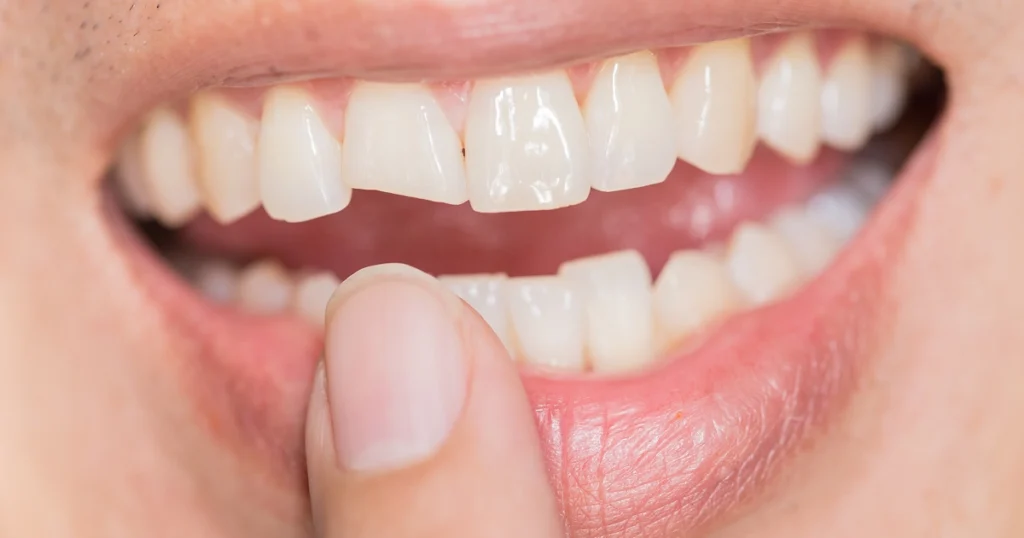
- Minor enamel chip — a small piece of the hard outer surface breaks off. Often painless and mostly cosmetic, but still worth checking.
- Larger chip into the dentin — the break reaches the softer layer beneath the enamel, which can bring on sensitivity to hot, cold, or sweet.
- Cracked tooth — a crack runs from the chewing surface downward. Cracks are sometimes invisible to the eye and can cause a sharp twinge when you bite or release pressure.
- Broken cusp — a pointed part of the chewing surface breaks away, common around older fillings.
- Tooth broken down to the gumline — a serious break that usually involves the pulp and needs prompt care.
- Cracked or split root — a crack that starts in the root, often below the gum, which may cause deeper discomfort or infection.
Here’s the important part: the extent of the damage isn’t always something you can see or feel. A “cracked tooth” can ache only when you chew, and a chip can hide a deeper fracture. Only a hands-on exam and dental imaging can confirm what’s really going on.
How Dentists Repair a Chipped or Broken Tooth
The reassuring reality is that dentistry has a repair matched to nearly every kind of break, and your dentist will tailor the plan to your specific tooth:
- Dental bonding — a tooth-colored resin shaped and hardened onto the tooth, ideal for small chips.
- Veneers — thin custom shells often used for cosmetic chips on front teeth, restoring a natural look.
- A crown — a cap that covers and protects a tooth with a larger break or missing cusp.
- Root canal, then a crown — if the break has exposed or infected the pulp, the dentist clears the infection and then protects the tooth with a crown.
- Extraction with a replacement — for a tooth broken beyond saving, removing it and replacing it with an option such as a dental implant restores both function and appearance.
Costs for these options vary widely depending on the tooth and the approach, and the only way to know your plan is an exam — there’s no one-size-fits-all number, and nothing here is an EXO quote.
Why You Shouldn't Wait, Even Without Pain
It’s tempting to shrug off a chip that doesn’t hurt. But a break or crack creates a doorway: it can trap bacteria, worsen a little more with every bite, and lead to decay, nerve involvement, or a larger fracture that’s harder and costlier to fix later. A crack that’s small and simple today can become a tooth that needs a root canal — or can’t be saved — down the road. Painless truly does not mean harmless. The sooner it’s evaluated, the more conservative and affordable the fix tends to be, so it’s worth scheduling a prompt exam even when you feel fine.
Preventing Chips and Breaks
A few habits go a long way. Skip chewing ice, hard candy, popcorn kernels, and pens. Wear a mouthguard for contact sports, and ask about a custom nightguard if you grind or clench your teeth while sleeping. And keep up with routine checkups — regular visits let your dentist catch weak spots, worn fillings, and early cracks before they turn into a broken tooth.
Chipped or broken a tooth?
Don’t wait for a small problem to become a bigger one — the sooner it’s looked at, the simpler the fix usually is. Call EXO Dental and we’ll help you see an emergency dentist, ease your discomfort, and get your tooth repaired with a plan built around you. Our team is here to make a stressful moment feel manageable.
EXO Dental serves patients at three offices: Rogers, AR · Topeka, KS · Van Buren, AR.
Frequently asked questions
Is a chipped tooth a dental emergency?
It depends on severity. See a dentist right away for severe pain, a large break exposing the inner pulp, bleeding that won’t stop, swelling, a loose tooth, or a sharp edge cutting your mouth. A small, painless chip is usually fine to book within a day or two — but still get it checked.
Can a chipped tooth be left untreated?
It’s not advisable. Even a painless chip can trap bacteria, worsen with chewing, and lead to decay, sensitivity, or a deeper break that’s harder to repair later. Getting it evaluated protects the tooth.
How do dentists fix a chipped front tooth?
For a front tooth, dentists often use bonding for small chips or a veneer for a more polished cosmetic result. Larger breaks may call for a crown. Your dentist matches the option to the size and location of the chip.
My tooth broke but doesn't hurt — do I still need to see a dentist?
Yes. A broken tooth with no pain is common, but painless cracks can still deepen, trap bacteria, and eventually involve the nerve. An exam and imaging are the only way to confirm the tooth is stable.
What can I do for the pain from a broken tooth right now?
Rinse gently with warm water, apply a cold compress to the outside of your cheek, take OTC pain relief as directed, and cover any sharp edge with dental wax. These are temporary measures — follow up with a dentist promptly.
Will I need a crown or a root canal?
It depends on how deep the break goes. A break that reaches the pulp often needs a root canal followed by a crown, while a break that spares the nerve may only need a crown or bonding. Only an exam with imaging can tell for sure.